




TL;DR – What You’ll Learn
- YouTube pays Pakistani creators via international SWIFT wire transfer, which takes 3 to 5 business days and only reaches bank accounts. Mobile wallets are not part of the equation.
- TikTok’s Creator Fund is completely unavailable to Pakistan-based accounts as of 2026.
- Pakistan has over 70 million YouTube users and 66.9 million social media identities, but global payout systems were not designed for this market.
- Creator payouts span wallets, bank accounts, and cross-border transfers, depending on creator size. No single channel covers all tiers.
- FBR withholding obligations sit with the platform making payments, not just with the creators receiving them.
- Once a platform has more than a few hundred creators, manual payout processes collapse under the weight of compliance, reconciliation, and failed transactions.
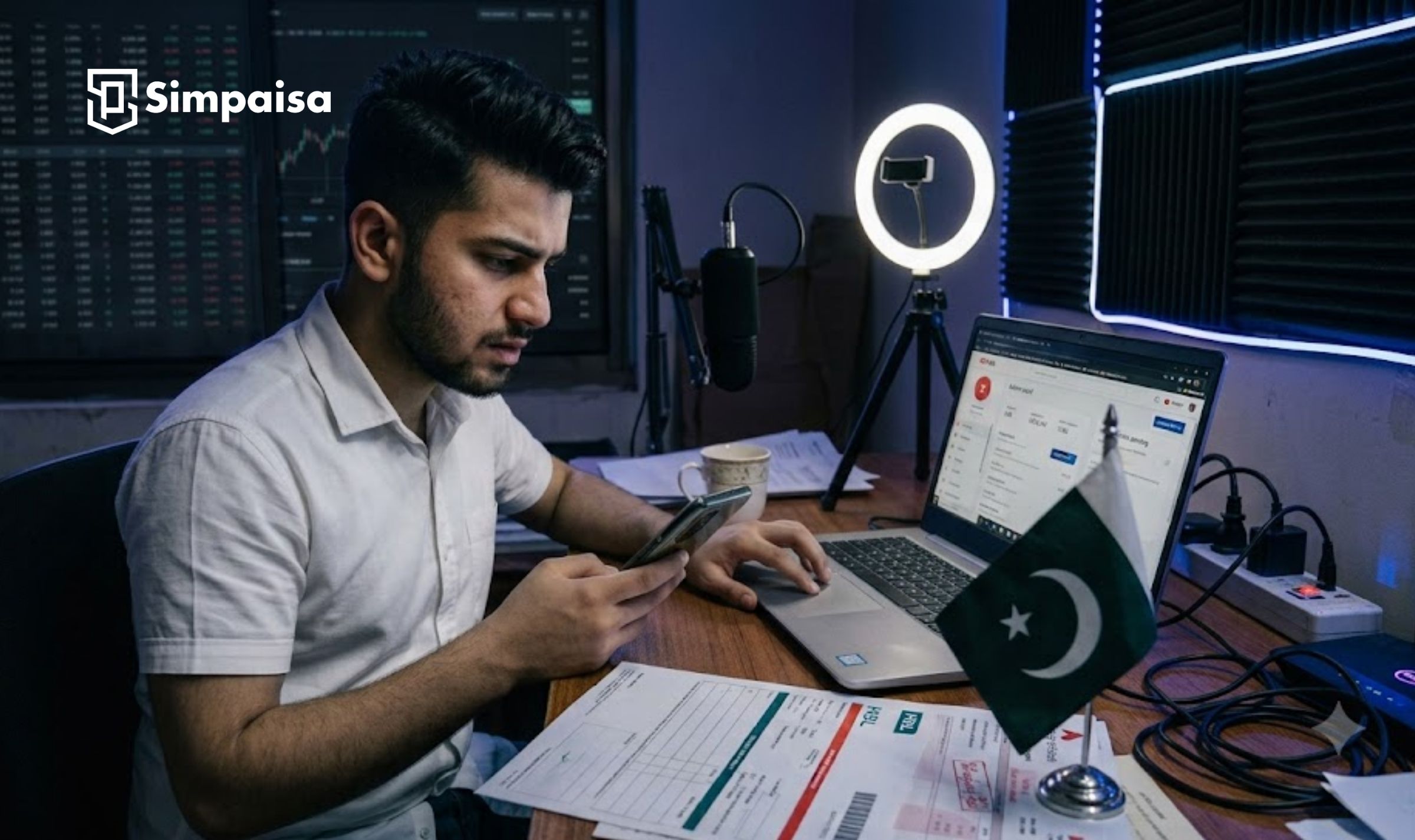
Content creator payouts in Pakistan work differently from anywhere else in the world. The infrastructure that YouTube, TikTok, and Meta use to disburse creator earnings either arrives slowly, misses wallet-based creators entirely, or does not work in Pakistan at all. For any platform building or running a creator monetization model here, these are not edge cases. They are the default.
How YouTube and TikTok Pay Content Creators: Where Pakistan Falls Short
Pakistan has over 70 million YouTube users and more than 60 million TikTok users, according to a September 2025 report in The Friday Times. Yet neither platform has solved the payout problem for Pakistani creators.
YouTube’s AdSense pays creators in Pakistan through international wire transfer via SWIFT. Payments are processed monthly, take 3 to 5 business days after the payment threshold is hit, and land only in a Pakistani bank account. JazzCash, Easypaisa, HBL Konnect, and Alfa wallets are not part of the AdSense payout system. That immediately excludes a large share of creators who operate primarily through mobile wallets.
TikTok’s situation is more direct. The Creator Fund and Creativity Program Beta are not available to Pakistan-based accounts. As of 2026, TikTok’s direct creator monetization programs operate only in the United States, the UK, France, Germany, Spain, and Italy. Pakistani creators build income through brand deals, live gifts, and affiliate arrangements, but TikTok itself does not disburse earnings to them.
Facebook’s Content Monetization program, which consolidated In-Stream Ads, Ads on Reels, and the Performance Bonus into a single earnings model from August 2025, pays eligible creators based on content performance. Regional availability still varies, and payouts are routed through international bank transfers in most markets.
The pattern across all three platforms is the same. Global payout infrastructure was designed for markets with high card penetration and stable international banking. Pakistan’s mobile-first, wallet-heavy financial ecosystem was not the reference point. For any platform building its own creator payout system here, that is the starting constraint.
What “Content Creator Payout” Means for a Platform Operating in Pakistan
Before building anything, it helps to be precise about what a content creator payout actually covers, because the term is used loosely and the difference matters for infrastructure decisions.
There are two fundamentally different types of payouts a platform makes to creators. The first is campaign-based: a brand or platform pays a creator a fixed fee for a sponsorship, a video, or a content series. This is typically a one-to-one transfer, often negotiated and processed manually. The second is revenue-share or creator-fund disbursement: a platform distributes earnings to a roster of creators based on views, engagement, or other performance metrics. This happens at scale, often monthly, and involves hundreds or thousands of recipients.
Both involve content creator payouts in Pakistan, but they require very different infrastructure. A brand sending a one-time payment to a single creator has different needs from an OTT platform distributing revenue shares to 2,000 creators every month. The challenges covered in this blog sit primarily in the second category, because that is where manual processes break down and where payout infrastructure decisions carry long-term consequences.
From Rs. 5,000 to Rs. 5,000,000: Why Creator Payouts in Pakistan Can’t Use One Infrastructure
One factor that makes content creator payouts in Pakistan more complex than most markets is the enormous range of creator sizes a platform may need to serve at the same time.
A micro-creator earning a few thousand rupees per month from brand deals or affiliate commissions expects to receive money via JazzCash or Easypaisa. That is where their financial life happens. They may not have a formal bank account. This reflects Pakistan’s broader financial picture: 79.2 million people use branchless banking wallets, according to the SBP’s FY25 Annual Payment Systems Review, compared to 24.1 million mobile banking users linked to formal bank accounts.
A mid-tier creator earning Rs. 300,000 to Rs. 500,000 a month likely has a bank account but may still prefer wallet disbursement for speed. They are also starting to think seriously about tax documentation, which changes how they want payments structured and recorded.
A top-tier creator earning millions monthly, or a production house working with major brands, needs formal bank transfers, proper documentation for FBR filings, and, in some cases, a payment structure that accounts for withholding tax deductions at source. Sending a Rs. 3 million payment to a JazzCash account is not the right answer, and depending on wallet transaction limits, may not even be possible.
A platform that tries to serve all three tiers with the same payment method will either fail smaller creators by requiring bank accounts they do not have or create compliance exposure by sending large-value payments through channels without proper audit trails. The answer is a disbursement system that routes each payout to the right channel based on the creator’s profile, not a single method applied uniformly across the roster.
Tax Withholding and KYC: The Compliance Layer Global Platforms Don’t Handle for You
This is where most international platforms building a Pakistan creator program get caught. They assume the creator handles their own tax compliance. In Pakistan, that assumption is incomplete.
Under the Income Tax Ordinance 2001, a platform making payments to Pakistani creators may carry withholding tax obligations depending on the payment type, creator registration status, and whether the payment qualifies as a business payment. For creators registered with the Pakistan Software Export Board (PSEB), the applicable withholding rate on export earnings is 0.25%. For non-registered individuals, the rate is 1% on gross earnings. Non-filers face double withholding rates on most transaction types, which creates both a compliance obligation and a reconciliation challenge for the platform processing the payment.
Beyond withholding, the platform needs to collect KYC documentation from creators before disbursing, both to meet its own compliance requirements and to generate the audit trail that FBR expects. This means collecting CNICs, verifying NTN registration status, and keeping records that match each payment to a verified identity.
None of this is unmanageable, but it requires integrating compliance checks into the payout workflow from the beginning, not adding them after a payment problem appears. Platforms that approach this well also tend to have cleaner relationships with their payment partners. For a closer look at what compliance-first payment infrastructure looks like at the certification level, Simpaisa’s PCI DSS compliance guide covers the standards that sit underneath any compliant payout operation.
From One Creator to Thousands: The Bulk Payout Challenge
Pakistan has 66.9 million social media user identities, according to DataReportal’s January 2025 report. The creator segment within that population is large and growing. The moment a platform moves from paying a handful of creators to paying hundreds or thousands, the process changes completely.
Manual payout processes hit walls at scale in specific, predictable ways. Payment batches that took a few hours to process at 50 creators take days at 500. Errors that were easy to spot individually become invisible in bulk. Wallet confirmations tracked by hand become impossible to reconcile without automated reporting. A payout that fails at 2 a.m. on month-end because a wallet account was unverified or a bank account number was entered incorrectly leaves the creator waiting with no visibility into why.
The difference between a manual payout operation and a properly built automated payout system is not just speed. It is the difference between a process that scales with creator growth and one that eventually falls apart under its own weight. Platforms that have grown creator communities know this transition point well: the payout process that worked at 100 creators is not the same one that holds up at 10,000.
A proper automated disbursement system handles creator payments in batches, validates account details before execution, routes each payment to the correct channel per creator profile, and generates reconciliation reports that match against the platform’s internal earnings records. This is the operational baseline for any platform running a creator fund or revenue-share model at real scale.
Paying Pakistani Creators When Your Platform Isn’t Based in Pakistan
For international platforms, and for platforms headquartered outside Pakistan that have Pakistani creators in their network, there is an additional layer to the payout challenge: getting the money into Pakistan in the first place.
Cross-border remittance into Pakistan is a regulated activity. Platforms cannot wire money into Pakistani wallets from abroad without going through proper channels. The State Bank of Pakistan requires that foreign payments to individuals come through licensed banking or remittance infrastructure, and creators need to account for inflows correctly for FBR purposes.
Pakistan’s digital payment ecosystem shows how significant this infrastructure is. Digital payments accounted for 92% of all retail transactions by December 2025, according to an SBP quarterly review, with mobile apps and wallets handling 83% of all digital activity. The infrastructure for moving money into and through Pakistan at scale exists, but accessing it requires either a local banking relationship or a licensed partner who handles the corridor from the sending country to Pakistan’s last-mile distribution points.
Platforms that try to solve this informally, through peer-to-peer transfers or unregulated channels, create problems downstream for their creators. The creator cannot account for the income correctly, the platform has no compliance trail, and both parties carry regulatory exposure. Simpaisa’s remittance infrastructure is built specifically for this use case: cross-border disbursement into Pakistan that routes to the creator’s preferred channel at the receiving end, whether that is a mobile wallet or a bank account.
Build vs. Buy: Why Platforms Don’t Build Local Payout Rails From Scratch
When a platform first considers how to handle creator payouts in Pakistan, building a proprietary solution looks attractive. Full control, no dependency on a third party, and the ability to customize every step of the payout flow.
In practice, building local payout rails means establishing direct banking relationships with multiple institutions, completing separate API integrations with each wallet provider, handling the compliance and licensing requirements that come with moving money at scale, and maintaining all of it as APIs change and regulations evolve.
JazzCash, Easypaisa, HBL Konnect, and Alfa each carry their own integration requirements, documentation standards, and operational support processes. Bank IBFT disbursement requires a different infrastructure again. Keeping live integrations with all of them running simultaneously is not a small engineering commitment, and it competes directly with the core product work that actually grows the platform.
The economics of build vs. buy in payments almost always favour buying the infrastructure and building the product. The platforms that have moved fastest are the ones that plugged into an existing disbursement layer rather than trying to replicate what payment specialists spent years building. Simpaisa’s payout disbursement platform covers JazzCash, Easypaisa, HBL Konnect, Alfa, and direct bank accounts through a single API integration, removing the need to manage each channel as a separate technical and operational relationship.
How Simpaisa’s Content Creator Payout API Works
The practical question for a platform ops or product team is what this actually looks like in production.
Simpaisa operates as a payment facilitator, providing the API layer above Pakistan’s wallet and banking infrastructure. For content creator payout use cases, the workflow runs like this:
The platform submits a batch disbursement request via API or file upload, with creator identifiers, payout amounts, and the preferred channel per creator. Simpaisa validates each recipient’s account details before execution, routes the payment to the correct channel (JazzCash, Easypaisa, HBL Konnect, Alfa, or bank account), processes the disbursements, and returns confirmation with transaction-level status for reconciliation.
File-based disbursement is available for platforms that prefer to manage batches via CSV upload rather than direct API calls. Both methods produce the same transaction-level reporting, which platforms use to reconcile against their internal creator earnings records and to document payments for compliance purposes.
Simpaisa is PCI DSS V4.0.1 and ISO 27001:2022 certified, which matters particularly for platforms that handle creator identity data alongside payment data. For platforms operating across markets beyond Pakistan, Simpaisa’s international coverage extends the same disbursement infrastructure to Bangladesh, Nepal, Iraq, Egypt, and Saudi Arabia, meaning a single integration can serve a multi-market creator program without managing separate payment relationships per country.
Expert Insight: Why Platforms Underestimate the Payout Problem Until It’s Too Late.
Most platforms building a creator program in Pakistan spend the large majority of their planning time on content strategy and community growth, and a fraction on payout infrastructure. That ratio inverts the moment there are 500 creators expecting payment on the same day. The payout problem in Pakistan is not just a payment problem. It is an infrastructure problem that requires deliberate decisions about channel mix, compliance, reconciliation, and cross-border flow before the first payment goes out. Platforms that treat payout infrastructure as an afterthought tend to discover its complexity at exactly the wrong time: when creators are waiting, and the platform’s credibility is on the line.
Giving Pakistani Creators the Payout Experience YouTube Couldn’t
YouTube’s wire transfer system, TikTok’s regional exclusion, and Meta’s performance-based models all share the same limitation in Pakistan. They were built for a different financial infrastructure and adapted imperfectly, or not at all, for this market.
The content creator payout experience Pakistani creators actually want is not complicated. Fast confirmation that money is on the way. Funds arriving in the channel are actually used. Documentation they can work with for FBR compliance. And consistency, so that payout day is something creators can count on, not something they have to follow up on.
Platforms that get this right build real loyalty. The payment experience is often the most tangible thing a creator platform delivers, more immediate than community features or content tools. Getting content creator payouts in Pakistan right is not just a technical requirement. It is a product decision that shapes how creators feel about the platform they chose to work with.
Talk to Simpaisa’s team about building a creator payout system that reaches every creator, on every channel, across Pakistan and beyond.
Frequently Asked Questions
Can platforms pay Pakistani content creators via JazzCash and Easypaisa in bulk?
Yes, but it requires an API integration or a file-based disbursement system connected to each wallet provider. Platforms handling more than a few dozen creator payouts per month typically route through a disbursement API that manages all wallet channels in a single submission, rather than processing each wallet separately.
What are the tax withholding obligations for platforms paying content creators in Pakistan?
Under the Income Tax Ordinance 2001, platforms making business payments to Pakistani creators may be required to withhold tax at source. The applicable rate depends on the creator’s FBR registration status and whether they are registered with PSEB. PSEB-registered creators have a 0.25% rate on export earnings; non-registered individuals are subject to 1% on gross earnings, and non-filers face double withholding rates. Tax obligations vary by transaction type and payment structure. Platforms should consult a qualified tax advisor for their specific situation.
How do international platforms send creator payouts to Pakistan?
Platforms based outside Pakistan need to use licensed remittance or cross-border payment infrastructure to disburse earnings to Pakistani creators. Unregulated peer-to-peer transfers create compliance exposure for both the platform and the creator. Licensed partners handle the inbound conversion and last-mile distribution to wallets and bank accounts, and the creator receives funds through a channel that can be accounted for correctly with FBR.
What happens when a wallet payout fails for a creator?
In a properly built disbursement system, a failed wallet payout triggers an automated exception report with the specific failure reason, such as an invalid account, a limit breach, or a suspended account. Platforms receive transaction-level status for each payout in the batch so they can identify and resolve failures before creators notice. Manual payout processes typically do not have this visibility, which means failures only surface when a creator reaches out to ask where their money is.
Does Simpaisa support multi-market creator payouts beyond Pakistan?
Yes. Simpaisa’s disbursement infrastructure covers Pakistan, Bangladesh, Nepal, Iraq, Egypt, and Saudi Arabia through the same API integration. For platforms with creator communities across multiple markets, this removes the need to manage separate disbursement relationships per country and keeps reconciliation in one place.
