




Over the last two weeks, I have had the privilege of sitting with founders, technologists, operators, and emerging companies through my engagement with NASTP Delta Lahore. The experience has been energizing, humbling, and deeply clarifying.
What I have seen is very simple:
- Pakistan does not lack brilliance.
- The ideas are real.
- The technical depth is real.
- The ambition is real.
- The founder energy is real.
- The problem-solving instinct is real.
Across fintech, AI, healthtech, cyber, circular commerce, education, energy, publishing, smart infrastructure, digital platforms, enterprise software, and emerging technology, I have met people building solutions around real problems — not theoretical ones.
Some are rethinking financial access and digital banking for the next generation — like the team building a wallet-first fintech targeting Gen Z and Gen Alpha, using open banking frameworks to serve the 70% of Pakistan that remains unbanked.
Some are rethinking trade-in models, circular commerce, and device lifecycle economics — with plans already underway to expand into Egypt, Saudi, and the UAE.
Some are building AI-enabled platforms for enterprises, education, health, compliance, and customer engagement.
Some are creating digital public goods for freelancers — global dollar accounts, instant PKR payouts at a fraction of industry rates — built by teams operating across Dubai, Taiwan, and Pakistan.
Some are working in the publishing sector, quietly serving millions of students across O and A levels, with a steady business that has grown over years without fanfare.
And some are exploring national-scale opportunities in infrastructure, cybersecurity, smart systems, and institutional transformation.
And yet, after these conversations, one observation stands above all others:
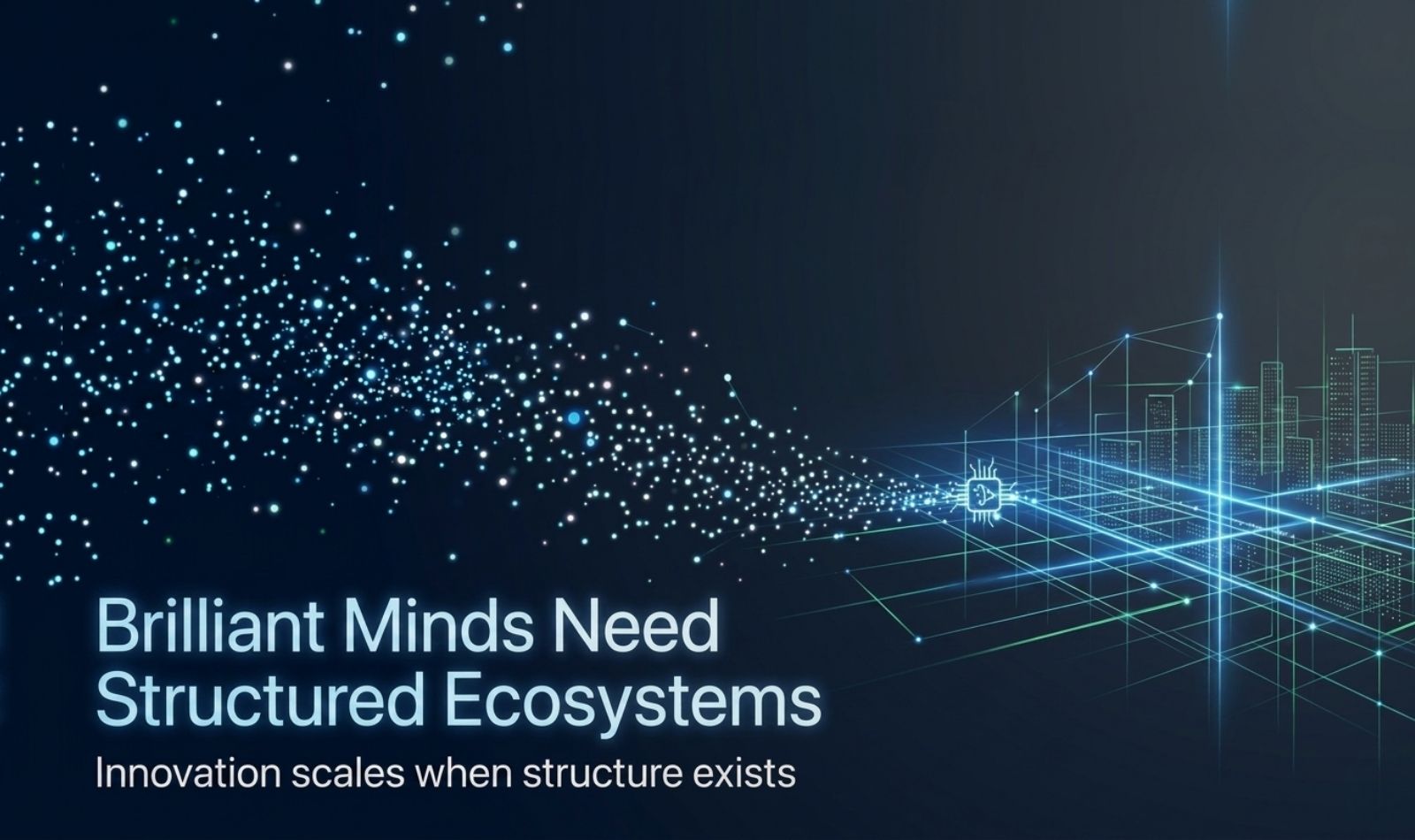
Innovation does not scale because it is brilliant. It scales when it becomes structured.
That is a lesson I have seen repeatedly across my own professional journey.
From early work with national telecom operators, to large-scale network transformation, strategic sourcing, procurement governance, data center delivery, API platform launches, digital banking enablement, regional technology initiatives, and institutional transformation across the GCC and Pakistan — the pattern has remained consistent.
Technology alone is never enough.
- A strong product needs positioning.
- A founder needs clarity.
- A company needs credibility.
- An idea needs an ecosystem.
- A market opportunity needs sequencing.
- And innovation needs institutional pathways.
This is where serious incubation becomes much more than office space.
A national-level incubation environment is not simply a building. It is not only a desk, a room, a floor, or a facility.
At its best, it is a system of confidence.
- It gives founders proximity to other companies.
- It gives them access to institutional stakeholders.
- It gives them exposure to regulatory pathways.
- It gives them commercial credibility.
It gives them talent pipelines, shared infrastructure, and a disciplined environment where ideas can mature into executable ventures.
For many emerging companies, the challenge is not capability.
- The challenge is isolation.
- They are building, but not always positioned.
- They are moving, but not always sequenced.
- They are technically strong, but not always institutionally ready.
- They have ambition, but not always the bridge into scale.
That bridge matters.
I have seen this play out in a recent conversation that stayed with me.
A founder was describing how well his solution worked in his home city. The product was solid. The team was sharp. The market fit was real. He looked at the opportunity and said, “I can get all this in my city.”
I asked him, “Then why don’t you do that?”
His answer was simple and honest: “We don’t have you there.”
A matter of a few conversations. A few telephone calls. A first meeting. And that was the bridge.
That is what a structured ecosystem provides. Not just an introduction, but the person who has walked both worlds, who knows the culture, the trust rhythms, the regulatory landscape, and the right doors on both sides.
In the last two weeks, I have seen how quickly a founder conversation changes when the discussion moves from: “What do you do?”
to:
- Where do you fit?
- Who needs this?
- Which ecosystem can accelerate you?
- What institutional advantage can support your growth?
- What regulatory, commercial, or strategic pathway should you align with?
- What should you do next?
That is where clarity begins.
And this, to me, is the next layer of national innovation infrastructure.
Not only roads, towers, networks, exchanges, data centers, and platforms.
But institutional infrastructure.
- The infrastructure of trust.
- The infrastructure of governance.
- The infrastructure of founder readiness.
- The infrastructure of ecosystem access.
- The infrastructure of structured opportunity.
Because brilliant founders do not need more noise.
- They need clearer pathways.
- They do not only need motivation.
- They need positioning.
- They do not only need introductions.
- They need alignment.
- They do not only need capital.
They need credibility, discipline, structure, and the right environment to mature.
This is why national-level incubation matters.
Because when innovation is brought into the right structure, it stops being scattered potential and starts becoming an executable national capability.
I have seen this same principle across different stages of my own journey.
In telecommunications, scale was not created by equipment alone. It required planning, sourcing, integration, governance, rollout discipline, and operational resilience.
In data centers, uptime was not achieved by infrastructure alone. It required standards, process discipline, engineering clarity, and execution control.
In API platforms and digital banking, services did not become national rails simply because the technology existed. They required ecosystem readiness, stakeholder alignment, compliance, trust, adoption pathways, and sequencing.
In procurement and strategic sourcing, value was not unlocked by vendor selection alone. It required governance, clarity of requirement, negotiation discipline, commercial control, and institutional accountability.
The same is true for startups.
A founder may have a brilliant product.
A startup may have real technical depth.
A platform may solve a serious market pain point.
But without structure, the opportunity remains fragile.
Without positioning, the market may not understand it.
Without governance, institutions may hesitate.
Without ecosystem access, growth becomes slow and expensive.
Without sequencing, energy gets diluted.
Without clarity, even brilliance can remain under-leveraged.
That is why I believe the next phase of innovation will not be won by ideas alone.
It will be won by the ability to structure ideas into trusted, scalable, institutionally aligned ventures.
This is especially important in Pakistan.
- There is no shortage of talent.
- There is no shortage of ambition.
- There is no shortage of young people willing to build.
- There is no shortage of founders who can see problems clearly and are willing to solve them.
What is needed now is a stronger bridge between innovation and execution.
A bridge between founders and institutions.
- Between products and markets.
- Between startups and regulatory pathways.
- Between talent and opportunity.
- Between national infrastructure and private-sector creativity.
- Between ambition and disciplined scale.
Between the founder who can build a solution in Karachi and the market that needs it in Riyadh or Muscat.
This is the work that excites me.
Because after years of working across national-scale technology environments — and spending the last two weeks inside one of the most ambitious innovation ecosystems in the region — I increasingly see startup incubation as the next infrastructure layer.
Not infrastructure in the traditional physical sense alone.
But institutional infrastructure.
- The layer that helps brilliance become visible.
- The layer that helps companies become credible.
- The layer that helps founders become ready.
- The layer that helps ecosystems become intentional.
- The layer that helps national innovation become executable.
My current work in this space is reinforcing something I have believed for a long time:
Clarity is not a soft concept. It is an operating advantage.
When founders gain clarity, they move faster.
When institutions gain clarity, they support better.
When ecosystems gain clarity, they scale with purpose.
And when a country egins to structure its innovation layer properly, brilliance becomes more than inspiration.
It becomes capacity.
That is the opportunity in front of us.
Pakistan’s innovation story is not waiting to be invented.
It is already here.
It is sitting in founder meetings.
It is being built in small teams.
It is emerging from universities, labs, offices, incubators, and technology parks.
It is visible in fintech, AI, healthtech, edtech, cyber, energy, automation, infrastructure, and enterprise platforms.
It is visible in the confidence of people who are building despite constraints.
The real task now is to structure it.
- To give it pathways.
- To give it credibility.
- To give it governance.
- To give it ecosystem access.
- To give it the institutional confidence required to scale.
Because the future will not be built by brilliance alone.
It will be built by brilliance that has been clarified, structured, and made executable.
 Written By:
Zeeshan Sabri
Clarifier | Founder of Award-Winning ClarityOS™
COO – CxO Global Forum
CEO – Kuantum
