




Pakistan’s digital payments market crossed Rs. 9.5 trillion in quarterly transaction volume in 2024, yet most businesses still lose customers at checkout. The payment gateway you choose determines your success rate, your margins, and how fast you can go live. This guide covers everything you need to make the right call.
TL;DR What You’ll Learn
- Pakistan’s digital payment transaction volumes grew over 40% year-on-year in 2024,
making gateway selection a critical growth decision, not just an IT procurement task - Not all gateways support JazzCash and Easypaisa, the two wallets covering 60M+
users in Pakistan. Missing either is missing your market - Hidden fees, redirect-based checkout flows, and slow onboarding are the three biggest
pain points Pakistani merchants report during gateway evaluation - Simpaisa is the only platform offering acquiring + disbursements + remittance through a
single API, across Pakistan, Bangladesh, Nepal, and Iraq - Go-live timelines vary wildly: some providers take 4–6 weeks; others get you live in days
- For marketplaces, ride-hailing platforms, and multi-sided businesses, payout rails
matter as much as card acceptance, and most local gateways don’t have them
Introduction: Why Choosing the Right Gateway Matters in 2026
Pakistan’s e-commerce market is projected to reach $6–7 billion by 2026, but only if merchants
can actually convert. Right now, cash-on-delivery (COD) still accounts for 60–70% of all e-commerce orders in Pakistan. The return rate on COD orders sits between 30–40%. On prepaid orders, that number collapses to
5–8%. That gap is not a consumer behaviour problem. It is a payment infrastructure problem.
Businesses that accept cards and wallets seamlessly see dramatically lower return rates and higher customer lifetime value. But picking the wrong payment gateway, one with redirect flows, limited wallet support, or poor API documentation, recreates the very friction you were trying to eliminate.
In 2026, the stakes are higher. SBP’s push for digital financial inclusion, Raast’s rapid expansion (crossing 100 million transactions in 2024), and JazzCash’s 40M+ registered user base mean the infrastructure exists. The question is which gateway connects you to it most efficiently and at what cost to your margins and your customer experience.
What Is a Payment Gateway? How It Works in Pakistan
A payment gateway is the technology layer that authorises and processes digital payments between a buyer, a merchant, and their respective banks or wallets.
In Pakistan, the transaction flow works like this:
- A customer selects a payment method: card, JazzCash, Easypaisa, or bank transfer (IBFT/Raast)
- The gateway encrypts and transmits the transaction data to the acquiring bank or wallet operator
- The acquiring bank requests authorisation from the card network (Visa, Mastercard) or wallet provider
- An approval or decline is returned in real time
- The gateway notifies both merchant and customer, and settlement begins
The Pakistan-specific complexity: Unlike mature markets, where card rails dominate, Pakistan runs on a dual infrastructure, with card networks and a mobile wallet ecosystem. According to the State Bank of Pakistan, over 100 million adults in Pakistan remain underbanked or unbanked, and for much of this population, JazzCash and Easypaisa are their primary financial instruments. A gateway that only processes Visa and Mastercard misses the majority of Pakistan’s active digital payment users.
Additionally, SBP’s Raast Instant Payment System, a direct bank-to-bank transfer rail introduced and rapidly scaled since 2022, has now crossed 100 million transactions, adding a third payment channel that progressive gateways are actively integrating. The right payment gateway in Pakistan in 2026 is not just a card processor. It is a unified access point to every major payment rail in the market: cards, wallets, and instant bank transfers.
Top 8 Payment Gateways in Pakistan: Features Comparison Table
Here is a structured comparison of the principal payment gateway options available to Pakistani businesses in 2026:
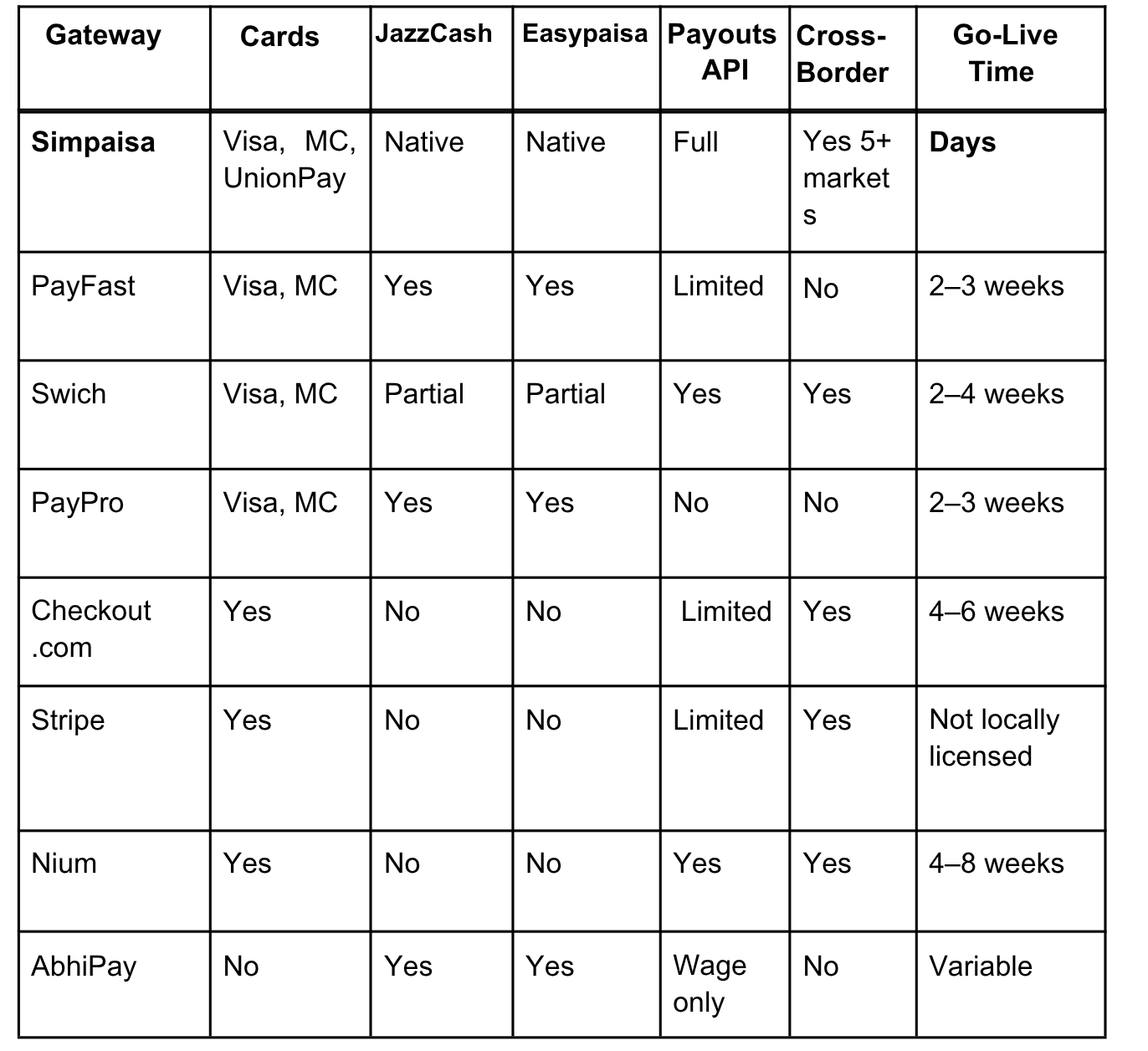
Key observation: Global platforms like Checkout.com and Stripe offer world-class card infrastructure but have zero integration with Pakistan’s dominant mobile wallets. This is not a minor gap; it means your checkout excludes the majority of Pakistan’s digital payment users. For any business primarily targeting Pakistani consumers, this is a disqualifying limitation regardless of how strong the brand name is.
Payment Gateway Fees Comparison Transaction %, Setup, Monthly
Fees in Pakistan’s payment gateway market are rarely published openly. Most providers quote rates based on business volume, vertical, and risk profile. That said, the typical market structure looks like this:
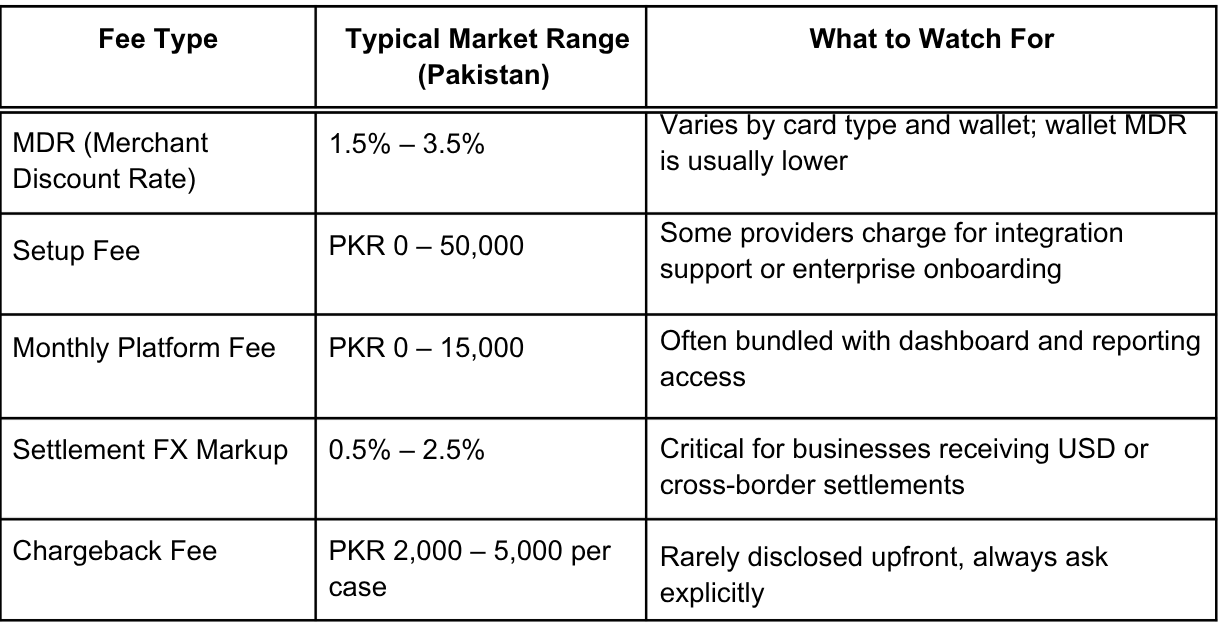
The MDR trap most merchants fall into: Many businesses focus on headline MDR and miss the FX markup on international settlements. A gateway charging 1.8% MDR with a 2.0% FX markup on USD settlements is materially more expensive than one charging 2.2% MDR with a 0.8% FX markup, particularly for businesses with international revenue.
A practical rule: always ask providers for your effective rate across your expected transaction mix, cards, wallets, and bank transfers, weighted by your actual volume split. If a provider cannot give you that number, it is a meaningful red flag about their operational transparency.
Pro Tip: Negotiate settlement timelines alongside rates. A gateway offering T+1 settlement at slightly higher MDR may be worth more to your cash flow than T+3 settlement at a lower rate, especially for high-volume e-commerce businesses managing inventory cycles.
Which Gateway Supports JazzCash & Easypaisa?
This is the single most important capability question for any Pakistani merchant evaluating a payment gateway in 2026.
JazzCash has over 40 million registered users. Easypaisa serves over 20 million. Together, these two wallets cover the large majority of Pakistan’s active digital payment users, millions of whom do not use credit or debit cards as their primary payment method. According to SBP data, Pakistan has 195 million+ mobile subscribers, and wallet adoption is deepening faster in Tier 2 and Tier 3 cities than card penetration.
A payment gateway that does not natively support both wallets is not a full-coverage solution for Pakistan.
Here is how the current market breaks down:
- Full native support (both wallets, zero redirect): Simpaisa
- Partial support (one wallet, or redirect-based flow): Several mid-tier local gateways
- No support: Stripe, Checkout.com, Nium, and most global platforms
The “no redirect” distinction matters more than most merchants realise. Redirect-based wallet flows, where the customer is pushed to a third-party page to complete payment, produce measurably higher abandonment rates. A clean, in-checkout wallet experience keeps the customer inside your funnel and reduces the cognitive friction that kills conversions on mobile.
Simpaisa’s single API connects merchants to 98% of mobile wallet users across Pakistan, with no redirect in the payment flow. For e-commerce and app businesses targeting Pakistan’s mobile-first consumer base, this is a direct, quantifiable conversion rate lever, not a nice-to-have.
Payment Gateway for E-Commerce vs. Apps vs. Marketplaces
Different business models have fundamentally different gateway requirements. Choosing a gateway built for a different use case than yours is a common and expensive mistake.
E-Commerce Stores (Shopify, WooCommerce, Custom)
Your priority is checkout conversion and minimal cart abandonment. Requirements: redirect-free flows, native wallet + card support, fast settlement, and a no-code payment link option for smaller merchants. Plugin availability for Shopify and WooCommerce is a practical prerequisite, but not every provider has maintained these integrations.
Mobile Applications
Your priority is SDK quality and in-app payment latency. Requirements: a lightweight API with minimal round-trip latency, optimised OTP flows, and robust error handling. Any friction in mobile checkout, extra screens, redirect loops, or OTP timeouts will depress your conversion rate. Pakistan’s mobile internet infrastructure, while improving, still creates latency sensitivity that gateway APIs need to be engineered for.
Marketplaces and Multi-Sided Platforms
Your priority is split payments, bulk payouts, and reconciliation. Requirements: the ability to collect from buyers and disburse to sellers, vendors, riders, or freelancers, ideally through the same unified platform. A gateway that handles acquiring but not payouts forces your engineering team to maintain two separate integrations, two separate dashboards, and two separate reconciliation workflows.
This third category is where most Pakistani businesses hit infrastructure limits. The majority of local gateways are collecting-only products. They have no payout API. Businesses in this category, marketplaces, ride-hailing platforms, e-commerce aggregators, and gig economy operators need a platform that handles both sides of the money flow. Simpaisa’s payment acquiring infrastructure is built explicitly for this, combining collecting and disbursing under a single API and a single integration effort.
How to Integrate a Payment Gateway: Step-by-Step Overview
For CTOs and technical leads evaluating integration complexity, here is a realistic overview of what the process involves across most Pakistani gateway providers:
Step 1: Account Setup and KYC (1–5 business days). Submit business registration documents, banking details, and compliance information. The timeline depends heavily on how complete your documentation is upfront.
Step 2: API Key Generation and Sandbox Access. Receive test credentials and access to a sandbox environment to simulate transactions. The quality of sandbox documentation varies enormously. This is your first real signal of how good the production experience will be
Step 3: Integration Build (2–5 days for experienced developers). Connect your frontend checkout and backend order management system to the gateway’s REST API. With clean documentation and a well-structured API, a competent developer completes standard card + wallet flows within this window.
Step 4: Webhook Configuration Set up real-time event notifications for payment success, failure, refund, and chargeback events. Poorly documented webhooks are the single most common source of integration delays.
Step 5: UAT and Compliance Review Test all payment scenarios in staging. The gateway’s compliance team reviews your integration for PCI DSS adherence before approving production access.
Step 6: Go Live Switch to production credentials, run a live validation transaction, and activate.
Total timeline: 7 days with a provider offering strong developer support, clean documentation, and a streamlined compliance process. Up to 4–6 weeks with providers that have long compliance queues, fragmented documentation, or legacy API architectures.
Pro Tip: Before signing any gateway contract, ask to see a working sandbox environment. If the sandbox is broken, incomplete, or undocumented, treat it as a direct signal about the quality of their production engineering support.
Simpaisa vs. PayFast vs. Swich vs. PayPro Comparison
This is the comparison Pakistani businesses conduct most frequently. Here is an objective breakdown without promotional language: The honest read:
PayFast is a solid domestic option for merchants who only need Pakistan-focused payment collection. It has good wallet coverage and a reasonable developer experience. Its ceiling is geography; no cross-border rails and limited payout infrastructure make it unsuitable for platforms or businesses with international operations.
Switch competes more directly at the enterprise and cross-border level. Its wallet coverage is less complete for domestic flows, and its onboarding timeline is among the longer ones in this group. International merchants with light domestic wallet requirements may find it workable.
PayPro functions well for straightforward collection use cases. The absence of a payout API makes it unsuitable for any business that needs to disburse funds to marketplaces, gig platforms, or any B2B disbursement workflow.
Simpaisa’s differentiation is scope: a single API covering acquiring, disbursing, and remittance across Pakistan, Bangladesh, Nepal, and Iraq with the shortest go-live timeline in the market and the broadest regulatory coverage (PCI DSS V4.0.1 + ISO 27001:2022).
Expert Insight: Why Most Businesses Get This Wrong
Most merchants evaluate payment gateways on MDR alone. That is the wrong metric. The real cost of a gateway is your effective cost per successful transaction, which factors in your authorization rate, your checkout abandonment rate from UX friction, your FX markup on settlements, and the engineering hours spent maintaining a fragmented multi-provider integration. A gateway charging 2.5% MDR with a 95% authorization rate and zero redirects often costs less, and earns more, than one charging 1.9% MDR with an 82% auth rate and a redirect-based wallet flow. In Pakistan’s mobile-first market, that UX gap alone can account for 10–15% in lost conversions at checkout, a number that dwarfs any headline MDR difference.
Verdict: Which Payment Gateway Should You Choose?
There is no universal answer, but there is a clear decision framework based on business type and growth trajectory.
Choose Simpaisa if:
●You need JazzCash and Easypaisa with zero redirect flows
● You operate a marketplace, platform, ride-hailing app, or any business that needs both
collecting and disbursing
● You are a global or regional company entering Pakistan, Bangladesh, Nepal, or Iraq and
need a single API that works across all markets
● You need cross-border remittance rails alongside domestic payment acquiring
● Go-live speed is a competitive priority.
Choose PayFast if:
●You are a Pakistan-only business with straightforward collection needs and no payout requirements
Choose Switch if:
●You are an international merchant prioritising cross-border rails and can accommodate a longer onboarding process
Choose Checkout.com or Stripe if:
● Your customers pay exclusively with international cards, you do not need local wallet support, and you are not operating as a locally licensed entity in Pakistan
The trajectory of Pakistan’s market is unambiguous. SBP data shows digital transaction volumes growing over 40% year-on-year. Raast is accelerating bank-to-bank payment adoption. Mobile wallets are penetrating Tier 2 and Tier 3 cities at a pace. The gateway that covers all of these rails, not just international cards, is the one that future-proofs your payments infrastructure for the next three to five years.
Conclusion
Choosing a payment gateway in Pakistan in 2026 is a strategic infrastructure decision, not a commodity procurement exercise. The right gateway determines your checkout conversion rate, your operational complexity, your settlement speed, and your ability to scale into new markets without rebuilding your payments stack.
Three things matter most: wallet coverage is non-negotiable for any business targeting Pakistani consumers; payout capability separates basic gateways from full-stack payment platforms; and go-live speed is a real competitive differentiator when market windows are short.
A fragmented integration, separate providers for collecting, disbursing, and cross-border transfers, costs more in engineering overhead and reconciliation than a unified API platform.
Start with your use case, not the price sheet.
Ready to see which Simpaisa plan fits your business? Get a free consultation with our payments team and go from evaluation to live integration in a very short time.
FAQ: 10 Most Asked Questions About Pakistan Payment Gateways
1.What is the best payment gateway in Pakistan for small businesses?
For small businesses, the best gateway combines zero monthly fees, fast integration, and full wallet support. If you anticipate growth or if you will eventually need disbursements, choosing a platform with that headroom upfront prevents a costly migration later.
2.Do Pakistan payment gateways support JazzCash and Easypaisa?
Not all of them do. Major international gateways like Stripe and Checkout.com have no JazzCash or Easypaisa integration. For any business targeting Pakistani consumers, native wallet support is essential.JazzCash alone has 40M+ registered users, many of whom do not use cards as their primary payment method.
3.How long does payment gateway integration take in Pakistan?
It varies significantly by provider. Some take 4–6 weeks due to compliance queues and fragmented documentation. API-first platforms with streamlined compliance processes can get you live in within days. Always ask for a realistic go-live estimate and check developer reviews before committing.
4.What is MDR, and how does it affect my margins?
MDR stands for Merchant Discount Rate, the percentage fee charged on each transaction. In Pakistan, MDR typically ranges from 1.5% to 3.5% depending on payment method, card network, and business volume. Always ask for your effective rate across your full transaction mix, not just the headline card rate. Wallet MDR is usually lower than card MDR.
5.Is Raast integrated with payment gateways in Pakistan?
Yes, several gateways now support Raast SBP’s Instant Payment System for real-time bank-to-bank transfers. Raast enables zero-cost transfers and is increasingly important for both B2B payments and higher-value consumer transactions. Confirm Raast support explicitly when evaluating any provider.
6.Can I accept international payments through a Pakistani payment gateway?
Most local gateways are domestic-only. For cross-border payment acceptance and international settlements, including USD receipts and FX conversion, you need a provider with international acquiring capabilities and transparent FX handling. Always ask for the settlement FX markup rate, not just the MDR.
7.What is the difference between a payment gateway and a payment aggregator?
A payment gateway connects your checkout to payment networks for authorisation and settlement. A payment aggregator bundles multiple merchants under one master merchant account, simplifying onboarding but sometimes reducing control over settlement terms and compliance scope. A licensed Payment Service Operator (PSO), the SBP licensing category operates at a higher compliance tier with direct regulatory accountability.
8.Do I need PCI DSS compliance as a merchant?
If your integration is built correctly, the gateway handles most of the PCI DSS scope on your behalf. However, your specific PCI obligations depend on your integration method: hosted, redirect, or direct API. Always confirm the PCI scope implications of your chosen integration approach before going live.
9.What happens if a payment fails? How are failure rates managed?
Payment failures in Pakistan are more common than in mature markets due to wallet OTP timeouts, mobile network latency, and card authorisation gaps. Better gateways use intelligent transaction routing to retry through alternate rails. Ask any provider for their reported transaction success rate and ask whether that figure is net of retries or first-attempt only.
10.Can a payment gateway also handle payouts to freelancers or vendors?
Standard gateways cannot. Payout capability requires a separate disbursement API or a unified platform that handles both acquiring and disbursing under one integration. For marketplaces and platforms that need to pay out to suppliers, creators, drivers, or freelancers, look specifically for a provider with a bulk payout API alongside its collection capabilities.
